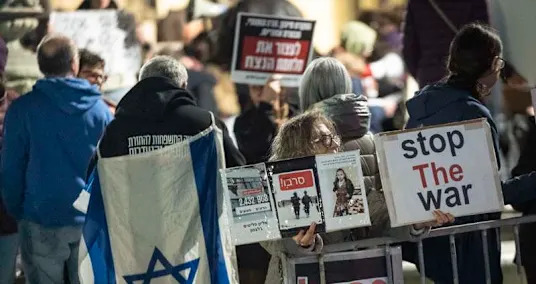
Demonstrators carried signs reading “We must stop” and “Bibi will kill us all,” while about 200 people gathered at Horev Junction in Haifa.
Anti-war demonstrations were held across Israel on Saturday evening, with protesters gathering in Tel Aviv, Haifa, Jerusalem, and Kfar Saba despite strict wartime restrictions on public assembly.
Demonstrators carried signs reading “We must stop” and “Bibi will kill us all,” while about 200 people gathered at Horev Junction in Haifa.
Earlier on Saturday, the Home Front Command granted an exceptional permit for a protest of up to 150 people at Habima Square in Tel Aviv, after state authorities told the High Court of Justice that demonstrations would be allowed only in a limited format and under tight attendance caps.
The Association for Civil Rights in Israel sought an urgent hearing, arguing that the restrictions harm the right to protest.

Security restrictions and court dispute
One IDF officer said the Home Front Command examined each requested protest site individually on operational, professional, and security grounds, including proximity to protected spaces. As a result, authorities did not approve a large gathering at Habima Square and instead allowed only 50 to 150 participants near a shelter.
The officer said the military declined to provide further details on all of its security considerations, but offered to present them to the court in a closed session.
“We are acting professionally and objectively. There is no political consideration here or any other consideration,” he said.
The requests covered several locations, including Habima Square in Tel Aviv, Horev Center in Haifa, Paris Square in Jerusalem, and Weizmann Street in Kfar Saba. In Tel Aviv, the state told the Supreme Court that the protest could proceed in two separate groups of up to 75 people each, for a total of 150 participants.
Protest groups push back
Police and the Home Front Command said the limits stemmed from operational and security concerns, against the backdrop of fears of missile fire and broader wartime restrictions on gatherings.
Civil rights lawyers, however, argued in court that earlier judicial remarks on the importance of political free expression during wartime had not been meaningfully implemented.
The dispute followed a tense High Court hearing on Friday, during which Supreme Court President Isaac Amit sharply criticized the state’s position.
The judges stressed that the right to protest does not disappear during war and said police should propose a framework that would allow demonstrations to proceed.
latest_posts
- 1
 Photos: Hundreds Gather at Bondi Beach After Deadly Attack
 - 2First Greenland, now Iceland? Annexation joke by Trump ally gets frosty response in the Arctic nation.
- 3The cave was pitch black – so to create this magical underwater shot, the photographer had to use all his camera expertise...
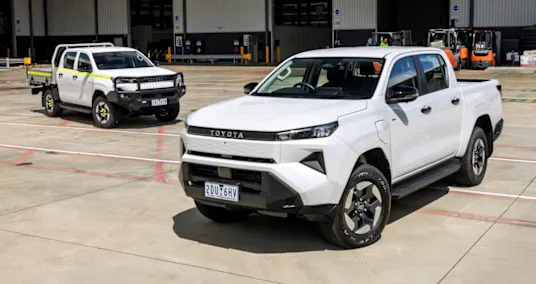
- 4The Electric Toyota Hilux Is Finally here, But It's Not Cheap
- 5Timothy Busfield turns himself in to face child sexual abuse charges in New Mexico




- EU-funded BioSupPack project turns brewery waste into bioplastics
- Volkswagen Plant Could Pivot From Building Cars to Supporting Iron Dome Systems
- Toyota Motor Europe to roll out smart EV charging through new partnerships
- UB professor shares his experience on almost becoming an astronaut
- Real time features for Films and Programs
- Defeating An inability to embrace success in Scholarly world: Individual Victories
- Netflix’s Price Hikes Just Got Rejected by an Italian Court. Here’s Why It Matters Everywhere
- Internet goes (cocoa) nuts: The funniest reactions to 12 tonne theft of KitKat bars
- Sahel coups push Africa to top of global democratic declines, report finds