When you buy through links on our articles, Future and its syndication partners may earn a commission.

CAPE CANAVERAL, Fla. — A massive solar eruption from the sun poses no threat to NASA's planned launch of its Artemis 2 mission to the moon this week, the space agency said today.
The colossal X1.4-class flare triggered a radio blackout over parts of Asia and Australia when it exploded from an active sunspot late Sunday (March 29) at 11:19 p.m. EDT (0319 March 30 GMT). The flare also launched a coronal mass ejection, or CME, of solar plasma in Earth's direction, but the space weather should settle down before NASA launches its Artemis 2 astronauts on April 1.
"We're not expecting the CME to cause any effects," Amit Kshatriya, NASA's Associate Administrator, told reporters here at the Kennedy Space Center during a press conference. "We're not tracking concerns for the mission in general."
Kshatriya said NASA's Artemis 2 mission management team gave the official "go" decision to proceed with a launch attempt on April 1. Liftoff is set for 6:24 p.m. EDT (2224 GMT). You can follow the mission with our Artemis 2 mission updates page and learn all about the flight in our Inside Artemis 2 video series.
"The team concluded that everything continues to look good and there are no issues preventing us from pressing ahead at this point," Kshatriya said.
Space weather can pose a serious risk for astronauts and satellites in space if an X-class flare, the most powerful type of sun storm, or CME blasts them with dangerous radiation. That's why NASA's Artemis 2 mission already has plans to test a space radiation shelter plan for its four-astronaut crew.
"One of our test objectives is to set up a radiation shelter, so we'll be doing that anyway, even without a radiation event," Artemis 2 flight director Emily Nelson told reporters during the NASA briefing. "Basically, we've got a section of the spacecraft that we would set up in and the crew would stay in that area until we gave them the all clear that the radiation event had passed."

The Artemis 2 mission is the first crewed flight around the moon since the Apollo 17 mission in 1972, and the first-ever to carry astronauts aboard NASA's Space Launch System (SLS) megarocket and Orion spacecraft. The mission will send four astronauts on a 10-day trip around the moon and back again.
Artemis 2 is commanded by veteran astronaut Reid Wiseman, with Victor Glover as pilot, both of NASA. Mission specialists Christina Koch of NASA and Jeremy Hansen of the Canadian Space Agency round out the crew.
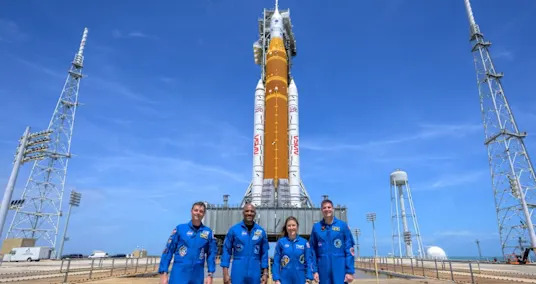
The astronauts arrived here at their launch site on Friday (March 27) and are in a prelaunch health quarantine. Today, they visited the launch pad and posed for a crew photo with their SLS rocket and Orion spacecraft. They are expected to have dinner with close family members at NASA's famed astronaut beach house, where astronaut crews have relaxed before missions for decades, Nelson said.

The astronauts may have had a phenomenal view of Florida's Space Coast. Shortly after NASA's press conference today, a dazzling double rainbow arced over the Kennedy Space Center on the heels of an afternoon drizzle. NASA is actually expecting clear skies on launch day, with an 80% chance of good weather for Artemis 2's liftoff.
Visit Space.com every day this week for complete coverage of NASA's Artemis 2 mission to the moon. If you're looking for ways to express your excitement, our Artemis 2 gear guide may have just what you need.
latest_posts
- 1
 A few Up-to-date Sacks - Stylish Young ladies Shouldn't Miss
 - 2Voting begins in Uganda’s presidential election during internet shutdown and polling station delays
- 3Investigating the World's Chief Authentic Urban communities to Visit
- 4'Backward and upward and tilted': Spaceflight causes astronauts' brains to shift inside their skulls
- 5The most effective method to Decisively Use Open Record Rewards


- 5 Pizza Fixings That Characterize Your Character
- Alice Wong, founder of the Disability Visibility Project, dies at 51
- 75% of Arab Israelis support Arab party joining government coalition post-war, survey reveals
- Chicago reports first rabies-positive dog in 61 years. What we know.
- NASA chief Jared Isaacman says Texas may get a moonship, not space shuttle Discovery
- Trump administration plan to reduce access to some student loans angers nurses, health care groups
- 6 Monetary Arranging Administrations for Your Necessities
- 3 astronauts settle into their new life in orbit | On the International Space Station this week Dec. 1-5, 2025
- The Delight of Camper Vans: Choosing the One That Meets Your Requirements


